
How to Check for a Warrant in Upshur County
The Sheriff's Office posts no public warrant search tool and no countywide active-warrant roster for Upshur County. So work the case from the court side. Search the county portal as an index, spot the likely court, then ask its clerk whether the record shows a warrant issued, recalled, or served. A city ticket belongs with that city's municipal court. Give the clerk a full name plus a case or citation number if you have one, and confirm the court, the case, the status, and your next step with the clerk or a Texas attorney. A blank portal result is not clearance.
- Search the official county court portal for a matching case, using a name or case detail the portal accepts.
- Identify whether the file belongs to the 115th District Court, County Court, a JP precinct, or a city court.
- Ask that court's clerk whether its own record shows an issued, recalled, or served warrant.
- For sheriff-held records, use the Sheriff's Office contact page or submit a focused Texas Public Information Act request.
- For a city citation or a reported FTA, contact the city or JP court that set the date; use DPS or OmniBase only for the separate FTA/FTP program question.
Upshur County Warrant Checks Start With Court Ownership
Every warrant question in Upshur County starts with one fact: the issuing court controls the case record and any recall. The Sheriff may serve a warrant or hold custody information, but that role does not turn the sheriff's public page into a substitute for a clerk's case file. The online portal is a case index, nothing more. It can omit municipal or JP cases, and it will not show live service status. Ask which court owns the case and what its record says right now. Start with the Upshur County court search portal, and read the warrant search guide for its fields and limits. For lower-court matters, the county's JP precinct page routes a question to the right court. A constable may serve a JP warrant, yet the JP court keeps the file and any recall.
Portal coverage and current status are separate questions, so verify a possible match with the issuing court.
Types of Warrants in Upshur County
Different court events produce different orders in Upshur County. An arrest warrant follows judicial review. A bench warrant or capias may follow a missed appearance or an unmet obligation, while a capias pro fine ties to a court fine. A search warrant, in turn, authorizes a defined search. These records can sit in different systems, and each may call for a different next step with its clerk.
| Record type | How it arises | Where to start |
|---|---|---|
| Arrest warrant | A magistrate issues a written order after the legal process required for an arrest. | The issuing court and the agency serving it. |
| Bench warrant or capias | A court responds to a missed setting or unmet case obligation. | The court that set the case. |
| Capias pro fine | A court uses a collection process for an unpaid judgment or fine. | The court that entered the judgment. |
| Search warrant | A judge authorizes a search under the criminal procedure rules. | The issuing agency or court, subject to access limits. |
Where a warrant was issued matters more than where a person lives in Upshur County. The arrest-warrant guide separates judicial issuance from service and custody.
Four JP Precincts Divide Lower Court Warrants
Upshur County runs four JP precincts, each with its own court contacts and lower-court duties. A citation or a missed setting belongs with the precinct that handled it. A constable's service role does not move the case to the Sheriff's Office. Use the county's official JP directory to reach the right office, give the clerk a case or citation number, and ask whether the court's own record shows a current order. Constables serve criminal warrants issued through JP courts and work bailiff duties, while the JP court handles the case and any recall. The precinct page lays out this service structure for routing purposes; it is not a warrant list. Check the county precinct page for current contact details before you call.
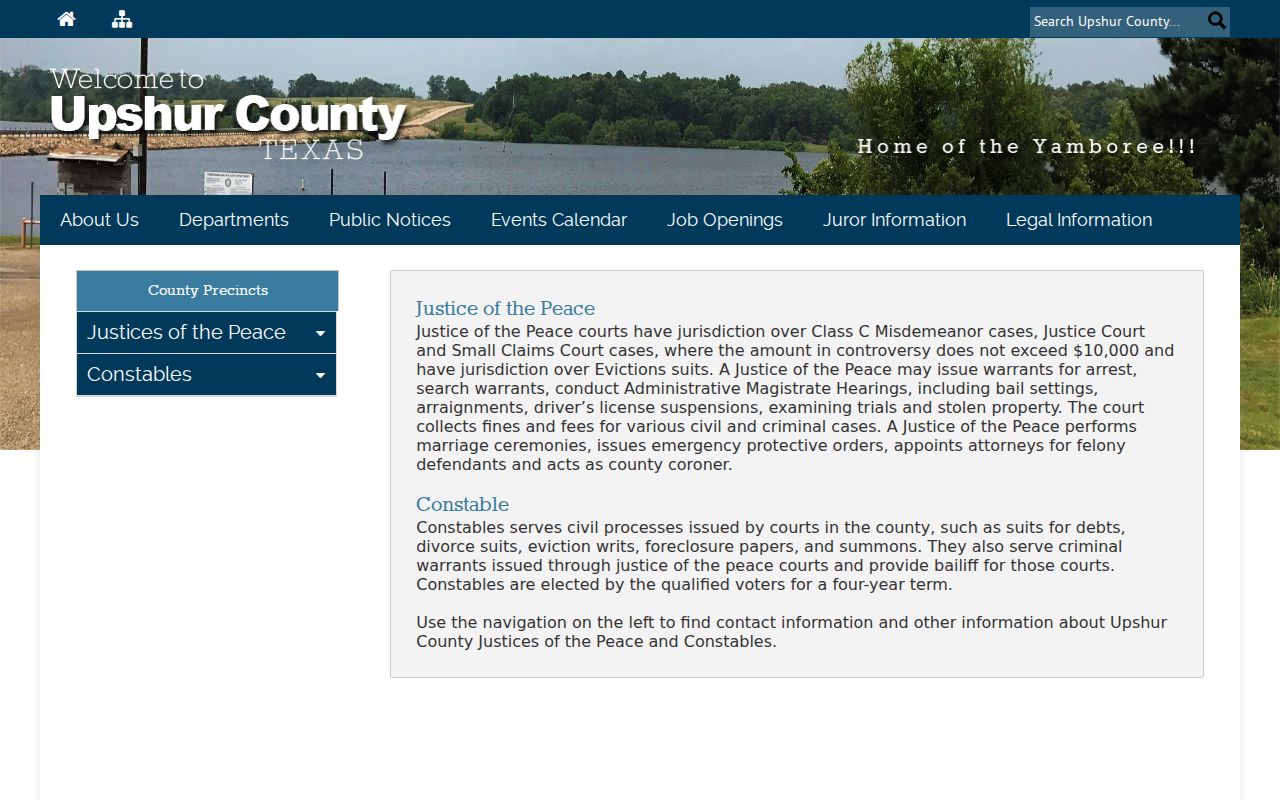
A precinct page is not a live docket. Use it to find the right Upshur County office, then ask that court directly for the case status.
What an Upshur County Warrant Record Shows
A public case screen may show only part of an instrument. Upshur County publishes no warrant-number format or status-code legend, so ask the clerk what each field means today.
| Case or warrant number | Use the number printed by the issuing office. No local public format was documented. |
|---|---|
| Named party | Compare the full name and other identifying details with the official case record. |
| Charge or basis | The entry may identify a charge or the court obligation tied to the warrant. |
| Issuing court | Shows which court controls the case and any request to recall the process. |
| Bond or fine | May be absent or case-specific. No countywide bond amount was located. |
| Status | Ask the custodian whether it means issued, served, recalled, paid, or something else. |
A copy of a record is not a live-status check. A file can lag after payment or service, and the court docket may differ from what the Upshur County Sheriff holds operationally.
Two Upshur County Clerks Keep Different Court Records
Two clerks, two record sets. The 115th District Clerk maintains district-court records in Upshur County; the County Clerk maintains County Court records, and neither office searches every JP, city, or law-enforcement system. Pick the District Clerk page or the County Clerk page that matches the court, then ask for the public portion of a specific case. Each clerk can explain its own index and copy process. Records held by an agency follow a separate request route: name the custodian, request a narrow record set, and call first if you are unsure which process applies.
Who Issues and Serves Upshur County Warrants
In Upshur County, judges and magistrates issue warrants; officers execute them. The Sheriff's Office handles county enforcement and custody. A JP constable's enforcement role stays distinct from a clerk's case-record duties. Neither service role makes an office the keeper of every court file.
Upshur County Sheriff's Office
Official county law-enforcement contact and service channel.
115th District Clerk
District-court record routing for cases held by that court.
Upshur County JP Courts
Four precinct courts; constables serve process from JP cases.
The Upshur County Sheriff page publishes no county warrant search. Use it for routing or a records request, not as proof that no warrant exists.
Upshur County Uses the Justice Center for Several Warrant Record Counters
The Upshur County Justice Center houses distinct offices. It is not one records counter. Before you visit, identify the case owner and read that office's current instructions; Upshur County publishes no walk-in surrender procedure, no jail bond-window hours, no accepted-payment list, and no identification rules. A general address or booking page cannot tell you whether a judge must act before a warrant is resolved or how bond gets posted. Ask the issuing court or your counsel. The Sheriff's information form is a records-request route, not a surrender appointment. For a request, identify the record, the date range, and the case number if known. The Sheriff's form lists possible charges for copies, labor, media, overhead, postage, email, and fax, so request an estimate or set a cost limit first. The portal may locate a case, the court can explain a setting or recall, and the Sheriff may confirm service or custody information it holds. Those are three separate functions, and each office answers only its own.
What to Do If You Have an Upshur County Warrant
Start by naming the court that issued the Upshur County warrant and having its clerk confirm the current status. That answer shapes everything. Talk to a licensed Texas attorney before any surrender or payment. The court may require an appearance, set bond, or weigh a request to recall the order; which route applies depends on the case. Never pay an unsolicited caller or an unknown private link. Verify every instruction with the court, keep receipts, and ask when its docket updates, because city-court options differ from county felony procedure.
Important: Speak with a lawyer about the issuing court and safe next steps before you appear; county sources do not publish a universal walk-in surrender promise.
Municipal Warrant Records Stay With Each City Court
In Upshur County, each city court keeps its own municipal warrant records. Gilmer posts court forms but does not confirm its amnesty terms. Gladewater's public list image is dated. Big Sandy gives new citations an entry period and limits pleas to the named party or counsel, while Ore City warns that payment removal can lag and East Mountain's file lists few fields. No sheriff page can replace a city-court warrant check, since lists run partial, stale, or silent on current status. The municipal court overview compares each local route.
Public Access to Upshur County Warrant Records
The Texas Public Information Act opens many Upshur County agency records, with exceptions. Court files follow judicial-access and criminal-procedure rules. A request can reach an existing public record, but it cannot create a report or a statewide clearance.
Key rules:
Texas Government Code Chapter 552 sets public-information duties and exceptions.
Texas Code of Criminal Procedure Chapter 15 covers arrest warrants and public access to specified records, within its limits.
Family Code Chapter 58 adds confidentiality protections for juvenile files.
Ask the Upshur County clerk holding the record. Protected details may be redacted, and the Sheriff's Office cannot provide files another court keeps, so direct that request to the clerk who holds them.
Texas FTA and FTP Status Is Not a County Warrant Search
DPS and OmniBase track failure-to-appear and failure-to-pay citations. Those reports can affect license renewal. A flag is not a warrant. DPS points citation questions to the reporting court, because its license staff cannot confirm one, and an FTA/FTP flag, a capias, and a license hold are three different records. If payment cleared with the court but not the state program, contact the reporting court or OmniBase. Neither a license hold nor a cleared flag shows whether an Upshur County warrant stands, and the DPS FAQ explains the program.
Upshur County Municipal Warrant Records by City
Municipal citations and warrants stay with each city's court. The five Upshur County city profiles here describe distinct local procedures.
Gladewater Warrant Records
Population 6,134. Check the municipal court and note the age of any posted list.
Gilmer Warrant Records
Population 4,843. The court publishes forms for pleas, extensions, and payment options.
Big Sandy Warrant Records
Population 1,231. Allow the court's stated entry period for new citations.
Ore City Warrant Records
Population 1,108. Its posting notice warns that list status can lag payment.
East Mountain Warrant Records
Population 899. The public list provides fewer fields than a complete warrant record.
Federal Warrant Records Sit Outside the Upshur County System
Federal warrants sit outside the Upshur County system. The county portal and Sheriff list skip them. Federal courts and federal law-enforcement agencies handle those cases, with Tyler's federal courthouse and the U.S. Marshals Service serving a different jurisdiction from local courts. For federal cases, use the federal docket and clerk. A county warrant search or a city list never covers federal records. For local matters, identify the issuing court and ask its custodian to confirm status, since no county-to-federal clearance search exists.